
You already know the system is broken. The cost of groceries keeps climbing. Entire neighborhoods get ignored by city hall. Decisions get made for you by people who'll never set foot on your block. So here's the real question: what if we stopped waiting for them to fix it and just built something better?
That's dual power.
The Basic Idea
Dual power is about building the institutions we actually need, right now. Community gardens that feed people. Assemblies where neighbors make real decisions together. Mutual aid networks where we take care of each other directly. Worker cooperatives where the people doing the work own the business. You don't need a grant proposal or a city council vote to start any of this.
The "dual" part is key. These new institutions exist alongside the old ones. We're not petitioning the system to reform itself. We're building a parallel system, one that's democratic and rooted in our communities, and as it grows, the old one matters less and less.
The IWW had a line for this over a hundred years ago: forming the structure of the new society within the shell of the old.
Where This Comes From
Lenin coined the term in 1917 to describe Russia after the Tsar fell. Two centers of power existed at the same time: the provisional government (the old guard) and the workers' councils, called soviets, that actually ran things on the ground. For Lenin, this was a temporary standoff. One side had to win.
We think about it differently. Murray Bookchin took the concept and turned it into something new. For Bookchin, dual power wasn't a crisis to be won by seizing state power. It was a long-term strategy for making the state irrelevant. Build democratic assemblies in your neighborhood. Make decisions face-to-face, not through representatives. Connect those assemblies into confederations. He called it libertarian municipalism.
The point isn't to take power. It's to build enough power from below that centralized authority becomes unnecessary.
Rojava
In northeast Syria, millions of people have been living this since 2012. In a war zone.
Abdullah Ocalan, the imprisoned Kurdish leader, read Bookchin and rebuilt the Kurdish liberation movement around his ideas. They call the system democratic confederalism. It starts with communes of 7 to 200 people.
These communes meet regularly. Residents decide together how to handle local issues, from distributing bread and electricity to settling disputes. Committees handle health, education, economy, self-defense, agriculture. Communes send delegates up to district and regional councils, but policy flows from the bottom.
The women's movement is the most radical piece. Every leadership position has a male and female co-chair. Women run their own autonomous communes and cooperatives. About half the agricultural land is now farmed by women's co-ops. After the revolution, 80% of the land went to the communes.
It's messy. It's difficult. It's also real, and it works.
Cooperation Jackson
Cooperation Jackson in Mississippi is doing this in the American South. Founded in 2014, it's a network of worker cooperatives built by and for the Black working class in Jackson.
They call their approach "Build and Fight." Build the alternative institutions. Fight the political battles that create space for those institutions to survive. They run Freedom Farms for urban agriculture, Nubia's Place Cafe for food service, and the Green Team for composting. The three feed into each other: compost goes to the farm, the farm supplies the cafe.
They hold People's Assemblies. They're buying land through community land trusts to block gentrification. They run time banks where an hour of anyone's labor is worth the same as anyone else's.
This works in places the system has written off. That's the point.
What We're Doing in Tulsa
At Cooperation Tulsa, every project we run is dual power in practice:
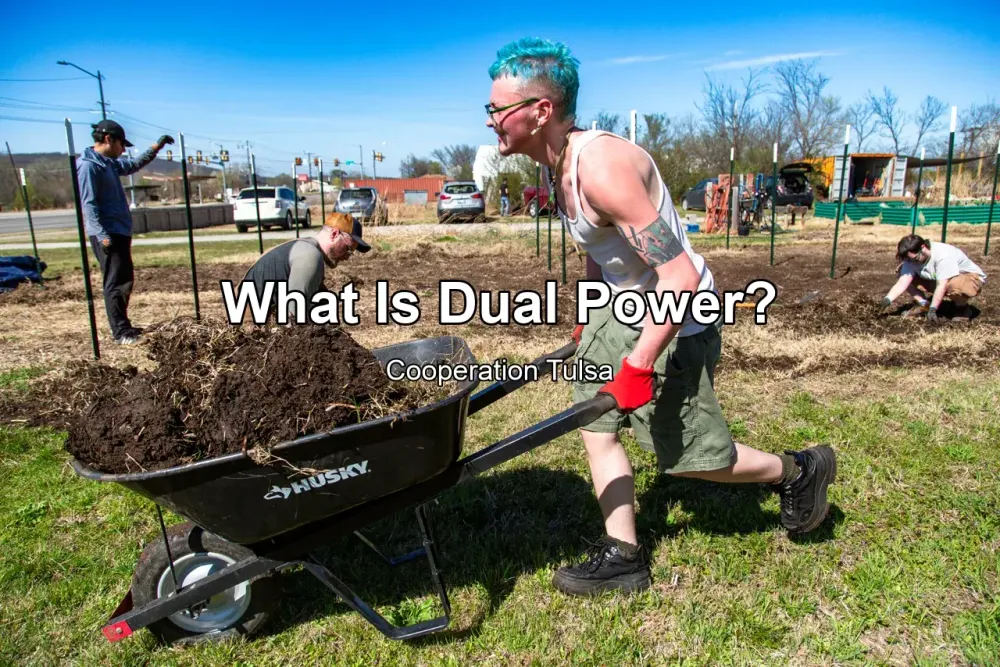
- Flat Rock Community Garden sits on 2.5 acres in north Tulsa. We grow our own food because food sovereignty means not depending on a system that creates food deserts and calls it acceptable.
- Popular Education sessions are free and open to everyone. We learn together because we don't need a university's permission to share knowledge.
- General Assemblies bring horizontal organizations from across Tulsa together to make decisions collectively. Our last one drew over 70 people.
- Mutual Aid means we distribute supplies and take care of each other directly. Solidarity, not charity.
Every Saturday at the garden, every assembly, every bonfire where we eat together and talk about what comes next. That's the work. We're not waiting for someone else to do it.
Why Now
Housing costs keep rising. Healthcare is out of reach. Groceries cost more and the food is worse. Government serves the people who fund campaigns. This is how the system works. It's not broken. It's functioning exactly as designed, just not for us.
So we build our own. A garden is a direct challenge to the food industry. A worker co-op is a challenge to corporate ownership. An assembly where your neighbors make decisions together is a challenge to the whole idea that we need people ruling over us.
A radical transformation requires radical action by us. There is no hero coming. We are the ones we've been waiting for.
Get Involved
Come to a work day at the garden. Show up to an assembly. Apply for membership. Read through our resources. Or just bring a friend and have an honest conversation about what kind of community you want to live in.
Revolution from the ground up, without rulers.